

How To Set Up Differential Equations
Differential Equations
A Differential Equation is anorth equation with a function and ane or more of its derivatives:
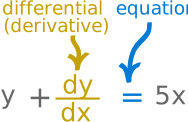
Example: an equation with the office y and its derivative dy dx
Solving
We solve information technology when nosotros find the function y (or ready of functions y).
There are many "tricks" to solving Differential Equations (if they tin exist solved!).
Simply first: why?
Why Are Differential Equations Useful?
In our world things modify, and describing how they change often ends up as a Differential Equation:

Example: Rabbits!
The more rabbits we accept the more baby rabbits we go.
Then those rabbits abound up and have babies too! The population volition grow faster and faster.
The important parts of this are:
- the population N at any fourth dimension t
- the growth rate r
- the population'due south rate of alter dN dt
Think of dN dt as "how much the population changes as time changes, for any moment in time".
Let u.s. imagine the growth rate r is 0.01 new rabbits per calendar week for every current rabbit.
When the population is thou, the rate of change dN dt is then 1000×0.01 = 10 new rabbits per week.
Just that is merely true at a specific fourth dimension, and doesn't include that the population is constantly increasing. The bigger the population, the more new rabbits we go!
When the population is 2000 we go 2000×0.01 = 20 new rabbits per week, etc.
And then it is improve to say the rate of change (at any instant) is the growth rate times the population at that instant:
dN dt = rN
And that is a Differential Equation, because it has a office N(t) and its derivative.
And how powerful mathematics is! That short equation says "the rate of modify of the population over time equals the growth charge per unit times the population".
Differential Equations tin describe how populations change, how estrus moves, how springs vibrate, how radioactive material decays and much more. They are a very natural way to describe many things in the universe.
What To Do With Them?
On its own, a Differential Equation is a wonderful way to limited something, but is hard to utilise.
So nosotros endeavor to solve them by turning the Differential Equation into a simpler equation without the differential bits, so we can practice calculations, make graphs, predict the future, and then on.

Example: Compound Interest
Money earns involvement. The interest can be calculated at stock-still times, such as yearly, monthly, etc. and added to the original amount.
This is called compound interest.
But when it is compounded continuously so at any time the interest gets added in proportion to the electric current value of the loan (or investment).
And as the loan grows it earns more interest.
Using t for fourth dimension, r for the involvement rate and V for the electric current value of the loan:
dV dt = rV
And here is a cool thing: information technology is the same as the equation nosotros got with the Rabbits! It just has unlike messages. So mathematics shows us these ii things behave the same.
Solving
The Differential Equation says information technology well, just is hard to utilize.
But don't worry, it can be solved (using a special method called Separation of Variables) and results in:
V = Pert
Where P is the Principal (the original loan), and due east is Euler's Number.
And then a continuously compounded loan of $1,000 for 2 years at an interest rate of 10% becomes:
5 = g × eastward(2×0.1)
V = thou × ane.22140...
Five = $1,221.40 (to the nearest cent)
So Differential Equations are swell at describing things, but need to be solved to be useful.
More than Examples of Differential Equations
The Verhulst Equation
Example: Rabbits Again!
Remember our growth Differential Equation:
dN dt = rN
Well, that growth tin't go on forever equally they will soon run out of available food.
So let'due south improve it by including:
- the maximum population that the food can support k
A guy called Verhulst figured it all out and got this Differential Equation:
dN dt = rN(i−N/thou)
The Verhulst Equation
Simple Harmonic Move
In Physics, Unproblematic Harmonic Movement is a type of periodic motion where the restoring force is directly proportional to the displacement. An example of this is given by a mass on a leap.
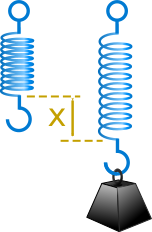
Case: Spring and Weight
A bound gets a weight fastened to information technology:
- the weight gets pulled down due to gravity,
- every bit the spring stretches its tension increases,
- the weight slows downwards,
- then the spring's tension pulls it dorsum up,
- then information technology falls back downwards, up and downwardly, again and again.
Draw this with mathematics!
The weight is pulled down by gravity, and we know from Newton's Second Constabulary that force equals mass times acceleration:
F = ma
And acceleration is the second derivative of position with respect to time, so:
F = m d2x dtii
The jump pulls information technology back up based on how stretched it is (m is the spring's stiffness, and x is how stretched it is): F = -kx
The ii forces are always equal:
m d2x dt2 = −kx
We have a differential equation!
Information technology has a part ten(t), and it'due south second derivative dtwox dt2
Note: we haven't included "damping" (the slowing downwards of the bounces due to friction), which is a little more complicated, but yous tin can play with it here (press play):
Creating a differential equation is the first major step. But nosotros also need to solve it to observe how, for instance, the spring bounces upwardly and down over time.
Allocate Earlier Trying To Solve
So how do nosotros solve them?

Information technology isn't always easy!
Over the years wise people have worked out special methods to solve some types of Differential Equations.
And so we need to know what type of Differential Equation information technology is first.
It is like travel: different kinds of transport have solved how to become to sure places. Is it near, then we can just walk? Is in that location a route so we can take a car? Or is information technology in another milky way and we just can't get there yet?
So permit us kickoff classify the Differential Equation.
Ordinary or Fractional
The first major grouping is:
- "Ordinary Differential Equations" (ODEs) have a single independent variable (like y)
- "Partial Differential Equations" (PDEs) take ii or more independent variables.
We are learning about Ordinary Differential Equations here!
Order and Degree
Next nosotros work out the Order and the Caste:
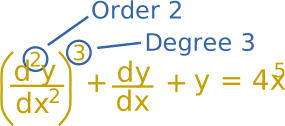
Society
The Order is the highest derivative (is it a start derivative? a 2nd derivative? etc):
Example:
dy dx + y2 = 5x
It has just the first derivative dy dx , then is "First Social club"
Example:
dtwoy dxtwo + xy = sin(x)
This has a 2d derivative d2y dx2 , so is "Order 2"
Example:
d3y dxiii + 10 dy dx + y = eten
This has a third derivative d3y dxiii which outranks the dy dx , so is "Order 3"
Caste
The degree is the exponent of the highest derivative.
Example:
( dy dx )2 + y = 5xii
The highest derivative is but dy/dx, and it has an exponent of two, so this is "Second Caste"
In fact information technology is a Starting time Order Second Caste Ordinary Differential Equation
Case:
d3y dxthree + ( dy dx )ii + y = 5xii
The highest derivative is dthreey/dxiii, but it has no exponent (well actually an exponent of 1 which is non shown), then this is "First Degree".
(The exponent of 2 on dy/dx does not count, as it is not the highest derivative).
So it is a Tertiary Order Beginning Degree Ordinary Differential Equation
Be conscientious non to confuse order with degree. Some people utilize the word lodge when they hateful degree!
Linear
It is Linear when the variable (and its derivatives) has no exponent or other function put on it.
And so no ytwo, y3, √y, sin(y), ln(y) etc,
just plain y (or whatsoever the variable is)
More than formally a Linear Differential Equation is in the class:
dy dx + P(10)y = Q(x)
Solving
OK, we have classified our Differential Equation, the next step is solving.
And nosotros accept a Differential Equations Solution Guide to help you.
Source: https://www.mathsisfun.com/calculus/differential-equations.html
0 Response to "How To Set Up Differential Equations"
Post a Comment