

How To Set Up Strelok Pro
And then yous are looking at using one of the most universally accepted ballistic apps in the world. Strelok Pro is arguable the best value-for-money ballistic app available. It fifty-fifty has a free version, albeit slightly limited in part.
I have been using the Strelok Pro version for effectually 5 years and just really understood many of its functions in the last few months. This prompted me to write a detailed but simplified guide to set up Strelok Pro and use it correctly at the range or in the field.
As I am certain you already know, time at the range is limited, so it is really depressing when yous leave the range, knowing that you spent most of your time at that place figuring out the app. A waste of valuable shooting time to be sure. And then to salvage you that time and hassle, here is a step by step guide broken into the following parts, in society:
- Initial Setup – How to prepare the Strelok App
- App Settings
- Measurement Units:
- Entering the rifle, armament, and scope data into the Strelok App.
- Scope data
- Bullet and cartridge information
- Zeroing your rifle and entering zippo data into the Strelok App
- Bullet speed
- Zeroing weather condition
- Twist charge per unit and direction
- Using the Strelok App in the field, correctly.
- Target information
- Current weather condition
I tin can tell yous right now that this is going to be a long ane. If y'all are looking for a specific feature or setting, y'all might desire to search this folio by hitting Ctr+F on your keyboard and typing in a keyword to find the correct section.
With all that said, permit'south dive right in.
ane. Initial Setup – How to set up the Strelok App
When y'all first get the Strelok app, and earlier you have a single shot, y'all will need to set the app to suit your needs and the units of measurement you will be using. You will then accept to enter your rifle information into the app too.
In this part of the guide, you will be setting up the following:
- Strelok App Settings
- Strelok App Measurement Units
*The post-obit settings are optional and will not be covered in this guide:
- Language
- Atmospheric condition Stations
- Bluetooth 2.0 Devices
- Keyboard Settings
Strelok App Settings:
To get to the Strelok App Settings, simply tap on the gear icon at the bottom left of the main screen from the abode page. You will be presented with the following settings:
Consider pulverisation temperature
Hotter powder burns faster and results in higher bullet velocities.
A written report by Sierra Bullets found that an increase in temperature of 44.5°F increased the muzzle velocity of a .308 from 2451fps to 2500fps. That's an increase of 49fps and quite a significant divergence.
By enabling "Consider powder temperature", Strelok factors in the temperature of the pulverization in the cartridge where a 1°F of temperature increase will increase the cage velocity by approximately 1 fps.
Show SMOA instead of MOA – What is SMOA?
SMOA is "Shooters Minute of Angle". SMOA is like to MOA, but not every bit precise. A truthful MOA is one.047 inches at 100 yards while an SMOA is rounded off to ane.0 inch at 100 yards. For long-range and precision shooting, I recommend that you not use SMOA, and use MOA instead.
Add together vertical deflection of crosswind to results.
Crosswind can cause a vertical deflection to the trajectory of the bullet. A x.6mph crosswind on a 308 Winchester 175gr bullet fired at 2550 fps can add 4.64 inches of vertical deflection at 600 yards. This value is approximately 10% (or slightly less) of the "spindrift" horizontal deflection. Nearly shooters recommend enabling this.
Add spindrift to results.
The spin of the bullet volition add a horizontal deflection to the bullet's trajectory. A correct-hand twist butt will cause the bullet to migrate right, and a left-manus twist to the left. It is recommended that this be enabled.
Add Coriolis effect to results.
The Earth'south rotation can have an consequence on the bullet'southward flight path. Vertical or horizontal depending on where on the Earth yous are and the management you lot are shooting. This effect is merely really noticeable at distances further than one,000 yards. If you are shooting that far, then exist certain to enable it.
Use photographic camera for gradient angle
This allows your camera to point at the target to summate the gradient angle from the main screen. It is a handy feature, then proceed it enabled.
Employ U/D and Fifty/R instead of +/-
Here you can make up one's mind whether to read the adjustments as U/D (up or down) and +/- (plus or minus). U/D is simpler to understand for all shooters, and it is recommended.
Show clicks in ane three/4 layout
If your telescopic is in MRAD, so I recommend leaving this disabled. If your scope is in MOA, and then I highly recommend y'all enable this function.
What exactly is "Show clicks in 1 3/four layout"? Instead of having to dial and count all the clicks, when working in MOA, information technology is more intuitive for many shooters to recall and piece of work in MOA and fractions of MOA.
In the example beneath, with "Testify clicks in 1 3/74 layout" disabled, the shooter must count each click, or divide the clicks by 4 or 8 (depending on if scope clicks are 1/4 MOA or 1/8 MOA), to visually dial in the adjustments, this can be disruptive and time-consuming on the wing.
With "Evidence clicks in i 3/74 layout" enabled, the shooter can quickly see that they must rotate the turret to "x" MOA and so add the advisable amount of clicks.
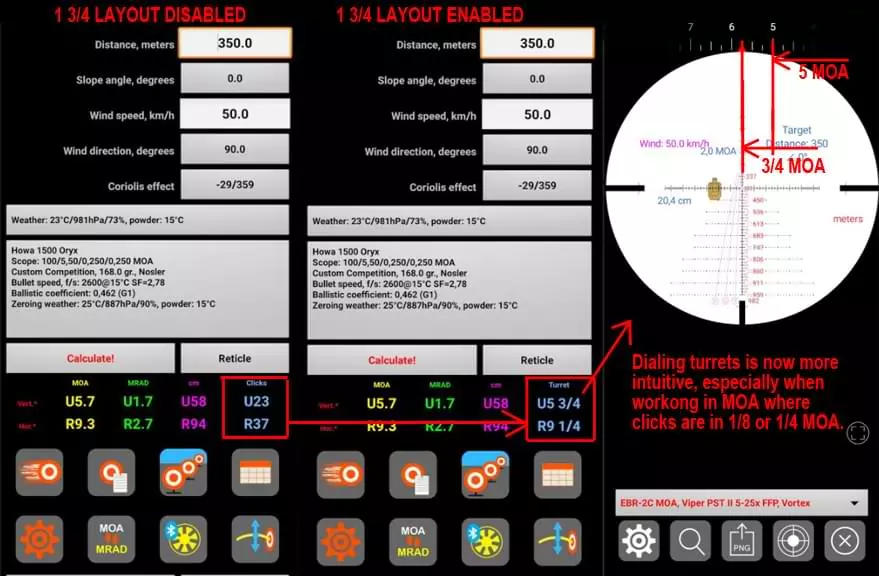
In the instance higher up, with "Show clicks in 1 3/74 layout" disabled, the shooter must count each individual click, which is difficult to practise under stress and piece of cake to brand a mistake. They could also dissever the clicks by 4 to get the MOA needed and rotate the turret speedily to that number. They can then add the fraction of MOA to that to become to the full aligning. The latter would be a better selection but takes longer.
With "Show clicks in 1 3/4 layout" enabled, the shooter immediately gets the amount of MOA to dial, and then the fraction of MOA to add together in one cord of numbers. This saves a lot of fourth dimension and avoids whatsoever confusion past division etc.
WeatherFlow WINDmeter back up
If you accept a WeatherFlow WINDmeter, enable this to connect the device and receive live wind speed updates to your shooting solutions.
Disable screen timeout
This volition prevent your screen from timing out and locking or switching off. This tin be a pain in the ass while shooting, and then it helps to have this enabled.
Turret step is equal to scope click.
If enabled, the virtual turret on Strelok's "Reticle" screen will match your rifle telescopic.
No sound effects
This is straightforward. Enable this setting to plough off the app audio effects.
Contrast color scheme
This will alter some colored text on your main screen to white, making it easier to read, particularly in direct sunlight. I recommend that yous enable this.
I accept Vectronix Rangefinder
If you have a Vectronix Rangefinder, and so you tin have the app automatically enter the altitude each time you lot use your range finder to measure your target distance.
Strelok App Measurement Units:
To get to the "Measurement units" screen, gyre downward to the lesser of the aforementioned settings screen and click on the "Measurement units" push button. Y'all are given the selection to either choose regal units, metric units or manually enter each unit ane by one. I recommend that you enter the units manually to match the units to your preference and the measuring equipment you use.
Distance units
Here you enter the unit of measurement for altitude that yous want the app to use. If your telescopic is MRAD, then I recommend that you use meters, and if your telescopic is MOA, I recommend that you see yards. This will make your calculations easier when ranging targets and making adjustments.
Inches or centimeters
For the same reason equally with "altitude units, " I recommend you use cm if your scope is MRAD or inches if your scope is MOA.
Scope top units
This is not actually important only refers to the unit used when entering your telescopic meridian in your scope settings when setting up your rifle. Your scope elevation is the distance from the center of the riflescope to the center of the bore.
Speed units
This is going to be based on preference. Ideally, you want this to friction match the settings on a chronograph if you lot have one.
Temperature units
Use what is native to your surface area. In nearly united states, yous will want to apply °F, because that is the format you'll get from virtually atmospheric condition stations and fellow shooters. In other parts of the world, °C is more native and is going to serve you better. Either way, you'll want to make sure that your thermometer or Kestrels units match the unit in these settings.
Pressure units
Here you need to set it to mmHg, hPa (mb), PSI, or inHg. For the aforementioned reasons every bit the temperature units, you'll want to choose the unit almost native to your area, making sure that whatever measuring devices are set to the aforementioned unit of measurement.
Wind speed units
Again, you'll want to apply the same unit that is used natively. You'll find yourself on the range, hearing air current calls from fellow shooters, and if y'all utilise the same units, yous can salve yourself a lot of guesswork and fault.
Distance units
Employ your native unit hither besides, either Meters or Feet.
Slope bending units
Hither you will use either Degrees or Cosine. Unless yous cannot use your phone'southward camera to measure out the angle through the app, y'all will want this to lucifer whatsoever measuring device you are using to measure the slope angle. For instance, if y'all are using a compass, then you should use Degrees.
Energy units
Free energy units are either Joules or Foot-pounds (ft-lb). Use whatever unit of measurement you lot and fellow shooters use and understand the nigh. This refers to the bullet's energy calculated by the bullet's weight and its velocity (speed).
Bullet weight units
Most bullets are weighed in Grains, which is true worldwide, so I recommend that yous utilize grains to save yourself from doing any conversions or getting confused.
Bullet length units
This is the length of the bullet itself from tip to tail. Use the unit of measurement of measurement that is printed on the packaging or published on the bullet manufacturers' website. Or, if you lot are measuring your ain bullets, and then match this to the units of the measuring device you are using.
Bullet diameter units
Same every bit the bullet length, match this unit of measurement to the unit used by the manufacturer of your bullets or the units on the measuring device if you lot measure your bullets yourself.
2. Entering the burglarize, ammunition, and telescopic data into the Strelok App
In this section, you need to enter some information virtually your burglarize, your scope and your armament.
Entering the telescopic data
To get to your telescopic settings, from the main screen, click in the large box that shows rifle, scope and cartridge data. You will now exist on the rifle settings, from here click on the first box that gives telescopic information. You should now be on the scope setting page as shown beneath.
You are presented with the following settings that I will encompass in the department.
- Zero Altitude
- Scope elevation
- Vert. click
- Hor click
- Scope click units
- Scope reticle
- This reticle is in First Focal Airplane (FFP)
- Min. magnification
- Min. magnification
- Max Magnification
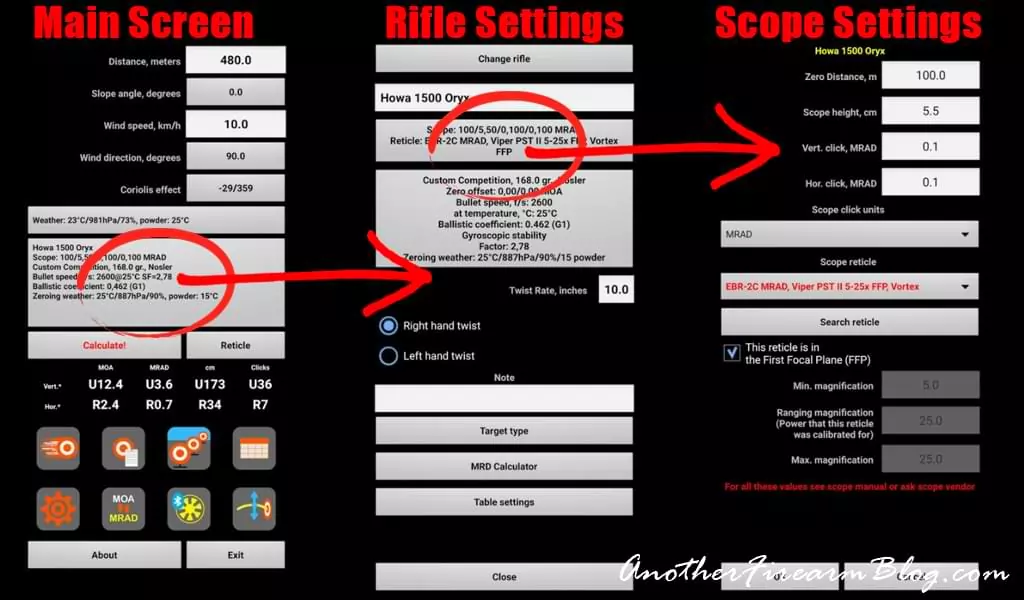
Zippo Altitude
The first setting under telescopic data is the zero altitude. Cipher distance is the distance at which yous sighted in your burglarize. Most rifle setups will be 100 yards if you utilize MOA and majestic units or 100 meters if you lot use MRAD and metric units. Even so, you can cipher your rifle at any distance, and the app will still work. Just make certain y'all enter the correct cipher distance here.
Scope superlative
This is the altitude betwixt the centerline of the rifle's bore and the centerline of the rifle scope. For best results, use calipers to measure this. For even improve results, use the following technique.
- Measure the exterior bore of the objective end of the rifle scope, and split that by 2.
- Measure the butt's outside diameter straight beneath the objective end of the rifle and split up that by two.
- Measure the altitude of the gap between the barrel and the scope.
- Add one, 2, and 3. This is your "Scope height".
Vert. click
Hither yous enter the value each click equals on your scope turrets. Most modernistic MRAD scopes will be 0.1 MRAD, and most MOA scopes will be 0.25 (1/4) MOA. At that place should be markings on your scope'due south turrets that specify what each click represents.
Hor click
This is the aforementioned as the above Vert. Click but for the horizontal aligning turrets. This will virtually likely exist the same as to a higher place. Nearly modern MRAD scopes will be 0.1 MRAD, and virtually MOA scopes will exist 0.25 (1/4) MOA. There should be markings on your scope's turrets that specify what each click represents.
Scope click units
Here you need to set the unit of your scope. For nigh scopes, it volition be between MOA and MRAD, and your rifle telescopic will have markings that display this.
Scope reticle
This peachy feature allows you to choose the same reticle of your burglarize scope. Strelok has a massive database of most of the modern riflescope models. Click "Search Reticle", type in the first few letters of your scope make, and ringlet until you run across your scope model, and so select it.
This reticle is in Commencement Focal Plane (FFP)
Y'all demand to tell Strelok if your telescopic is FFP (Offset Focal Airplane) or SFP (Second Focal Airplane). Look at the packaging or user manual to find out what your scope is. You tin as well expect online by searching your telescopic make and model on Google and visiting the manufacturer's website.
To make up one's mind if your scope is FFP or SFP, just look through the scope while adjusting the magnification. If your reticle stays the same size, your scope if you SFP, if your reticle grows as you lot zoom in, you have an FFP rifle telescopic.
Min. magnification
If your scope is SFP, y'all need to tell Strelok what the minimum magnification of your rifle telescopic is. This is the magnification when your telescopic is completely "zoomed out".
Ranging magnification
This is non required if your scope is FFP. This is where you enter the magnification that the scope reticle is calibrated for. You can find this in the user transmission or by looking at your manufacturer's website. The ranging magnification on most rifle scopes is prepare at the scopes maximum magnification or "total zoom".
Max Magnification
This is also not required if your scope is FFP. This is the scope's magnification when you are entirely "zoomed in".
Entering the bullet and cartridge data
The app needs some information nigh the type of ammunition you will be using. There are presets built into the app that covers most types of bullets and scopes. However, you should yet understand how to enter the rifle, scope, and ammunition data into the app manually and what these values mean.
To go to the Cartridge Settings screen, click on the big box with information about your rifle. This will take you to the rifle settings screen. From this screen, click on the large box with information about your "zero offset", "bullet speed", "ballistic coefficient" etc. This will take you to the cartridge settings screen.
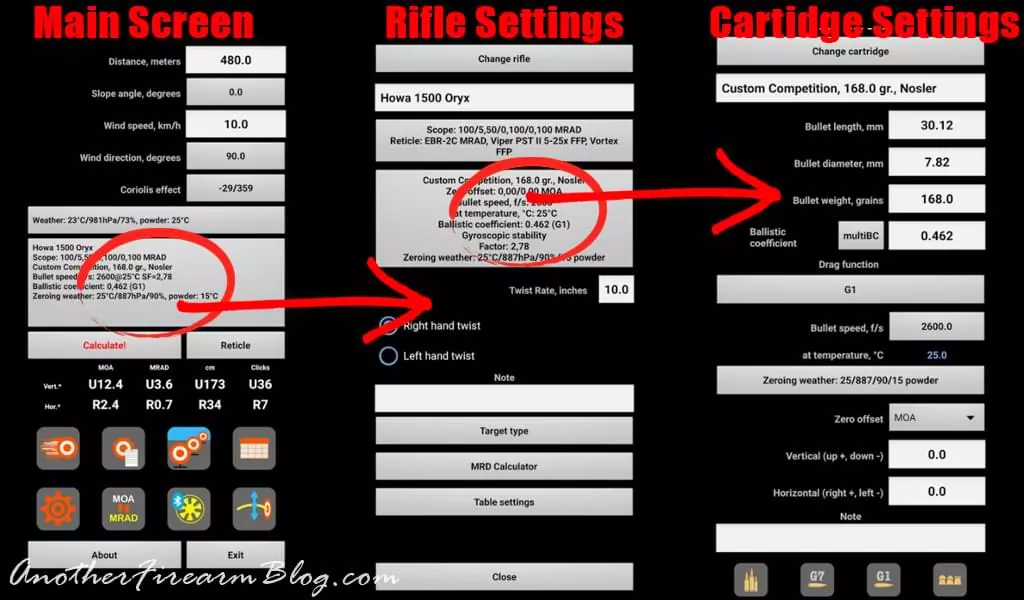
Alter cartridge
This is where you tin build profiles of unlike cartridges and save them for future employ. This feature is handy if you have different loads of cartridges for diverse purposes. For example, one type of cartridge for hunting and another for long-range shooting. By tapping on "Add" in the "Change cartridge" carte du jour, Strelok will salve your electric current cartridge settings and add them to a list of presets.
Cartridge name
Give your cartridge profile a name. If you are loading your own ammo, use something descriptive of your specific load, like: "Sierra Matchking 168gr, Lapua Brass, S&B Primer, 44.5gr N150". When you add your cartridge profile to the "change cartridge" presets, Strelok volition salve information technology under this proper noun.
Bullet length
This is the measurement of the actual bullet, from tip to tail, and not the measurement of the unabridged cartridge. You tin get this information on the packaging of your bullets or from the manufacturer'due south website. If you tin can't find this information, and then you volition need to measure it with a set of calipers.
Bullet bore
This is the bore of the bullet. This is besides available on either the box the bullets came in or on the manufacturer'due south website. This is essentially the caliber of the bullet.
Bullet weight
The bullet weight should be conspicuously shown on the product packaging. If not, then y'all can search the manufacturer's website, or alternatively, weigh them if you lot have the advisable scale. If you do counterbalance them, use an boilerplate of 10 bullets to give you a better result.
Ballistic coefficient – What is "Ballistic Coefficient?
The ballistic coefficient is a gene that is used to measure how aerodynamic a bullet is. In that location are two formats used in the shooting, G1 and G7. You should set which format your bullets are measured in beneath in the "drag office" setting. This value should be given on the box that the bullets came in. Alternatively, you should be able to observe the value on the manufacturer'south website. The ballistic coefficient is extremely of import.
- Multi BC
- As the bullet slows downwards along its flight path, its ballistic coefficient changes with its velocity. Some manufacturers, like Sierra Bullets, publish multiple BC's for unlike bullet speeds for more authentic calculations. If you accept this information on hand, then I highly recommend that you utilize it. To use Multi BC, simply tap on the "Multi BC" button, so enter each Ballistic coefficient and its corresponding bullet speed into the list.
Drag function
This is the format of the ballistic coefficient that you lot entered higher up in "Ballistic coefficient". For about bullets, information technology will be between G1 and G7. Be sure to check that yous are using the correct format past reading the packaging the bullets came in or past visiting the bullet manufacturer's website.
Bullet speed(This information will be entered at the adjacent stride)
You can enter the published bullet speed as per the packaging or manufacturer's website if you similar. However, you won't know the exact speed of the bullet fired in your rifle until y'all actually measure it with a chronograph. This should be done in the next step when you zip your rifle.
Zeroing weather(This data will exist entered at the next step)
You volition also only know this when you lot nil your rifle, so nosotros will save this for the next footstep.
3. Zeroing your burglarize and entering zero information into the Strelok App
OK, finally, it's time to get shooting! Here y'all volition exist doing two things. You volition zero the rifle at the preferred distance and enter your "Zeroing Weather" into the app. You should also measure your cage velocity.
You will demand at to the lowest degree a range where you tin can shoot 100m or 100 yards. You lot will need to naught your rifle and measure the muzzle velocity for the particular ammunition you volition be using for long-range shooting. Once you have done both, be sure to enter the "zeroing weather" (temperature, pressure, and humidity) into the app. It would as well be wise to write down this information in your shooting notebook.
Bullet speed
Yous tin can either enter the estimated bullet speed printed on the box of the ammunition, or you tin measure the speed with a chronograph. Make sure you measure at to the lowest degree v shots and take an average speed. Pay close attending to the ES (Extreme Spread) of the ammunition y'all are using. The ES is the divergence between the fastest and slowest speed out of your v shots. If it is likewise high (20fps or more), y'all will not get consequent results.
Zeroing weather
Considering altercation that affects the air density is ever changing, Strelok needs to know what the weather conditions were when you zeroed your rifle. Using this data and the weather data yous enter when y'all are shooting, Strelok can make corrections for the alter in weather. Be sure to update the "Zeroing weather" atmospheric condition every time you lot goose egg your burglarize.
- Enable zeroing weather condition
- Always have this enabled. It will allow yous to enter the "zeroing weather condition" atmospheric condition.
- Temperature
- Cold air is denser than hot air, and the higher air density will have more drag on the bullet, slowing the bullet down faster. To recoup for this, enter the ambience air temperature here. While shooting, be certain to update this throughout the mean solar day.
- Pressure
- The higher air pressure besides increases the air density, which volition have more drag on the bullet, causing it to boring down faster. Enter the air pressure here to compensate for this. Yous should get this in real-time at your shooting location using a Kestrel or similar weather meter. If you practice not have access to a meter, y'all can use your nearest atmospheric condition station information online.
- Use internal barometer
- Some modern devices have congenital-in barometers that can measure air force per unit area. If your device has this functionality, and then bank check this box. The Pressure level value above will automatically be updated for you.
- Humidity
- Boiling air is less dumbo than dry air, this might exist the opposite of what you'd kickoff expect, but information technology's truthful. Water has a lower molecular weight than nitrogen and oxygen, which ways the higher the humidity, the lower the air density, which slows the bullet down less than dry air would. To go your humidity, you volition have to utilize a Kestrel or similar weather meter. You can also use the value from your nearest weather station. Humidity has the least result on a bullet than anything else, so don't stress too much if you can't get it exact.
- Powder temperature
- This is enabled or disabled in the app settings under "consider powder temperature. As I mentioned, an increase of 1° F in pulverization temperature tin can increase a bullet's cage velocity by 1 human foot per second. This is because hot powder burns faster, which propels the bullet faster down the bore.
- To get the most out of this characteristic, proceed your ammunition in the shade and simply utilize the ambient air temperature for this. Alternatively, if you want to be a geek about it, you lot can apply a temperature gun to measure out it precisely.
- METEO
- The METEO characteristic in Strelok allows you to get a conditions update from the internet. If you take an internet connection, simply tap on METEO. It will take y'all to another screen, where yous await for a weather update. Subsequently a few seconds, it will prove the atmospheric condition conditions at your nearest weather station. If you are happy with the atmospheric condition, just tap on the "Use these values" button. Strelok will automatically enter all the weather values based on this update. While user-friendly, this will non be every bit accurate equally measuring the atmospheric condition weather manually at your exact location.
- Select Bluetooth weather condition station
- This is the small icon side by side to the METEO button. You can employ this function if you lot take a Bluetooth-compatible weather meter. If connected, Strelok will automatically get the weather conditions from the meter via Bluetooth.
Twist Rate and Management
This is the but data that Strelok needs near your actual rifle. The twist rate is when the rifling in the barrel twists and is denoted every bit 1:10 or 1:nine, for example. Typical twist rates for .thirty caliber rifles are one in 10, for case, which means the rifling completes one revolution for every x inches of length.
It is not usually necessary to measure your burglarize's twist rate as it is more often than not published in the transmission or the rifle manufacturer's website. If not, a good gunsmith volition be able to tell you the twist rate by giving him your make, model, and caliber of the rifle.
If your rifle barrel is a 1:x twist, you volition simply enter the value "10" into Strelok. You should also tell the app the management of the twist, right or left. Only tap on the appropriate check box for this.
Congratulations, you have completed the bones setup of the Strelok app. Next, you lot need to know how to use the app effectively in the field.
4. Using the Strelok App in the field, correctly.
OK, I know you lot are getting excited, but concur up, yous're not quite there nevertheless. While some of the information needed on the app'due south principal screen seems straightforward, there is more than than meets the centre.
Altitude – How to enter the altitude in Strelok
The first line on the home screen is distance. This is the distance from the muzzle of your rifle to the target. Use your range finder, or range the target using your tactical reticle to observe the range of the target if it is not marked or if it'southward not a known altitude target.
Suppose you cannot measure the gradient angle to the target every bit required in the following setting. In that instance, you can simply enter the HCD (horizontal distance component) here instead of the LOS (line of sight) distance. Near modern laser range finders can be gear up to give LOS likewise as HCD distances
Slope Angle – How to enter the slope bending in Strelok
The input is the slope bending to your target. You can either enter the slope manually in degrees or utilise your phone'due south camera to point the crosshair to the target, and the app will measure out the slope angle for y'all. Note: If your range finder has an HCD (Horizontal Component Distance), you volition non need to enter annihilation for slope bending and use the value 0.
Wind Speed – How to enter wind speed in Strelok
Next is wind speed. Here you will enter your air current speed in the unit of measurement that you prepare in under "settings". When entering the wind value, make sure you use the aforementioned unit of measurement in your Strelok Pro App as you are using in the Kestrel (or other devices) to measure the wind speed. If y'all exercise non have a Kestrel or wind speed measuring device, you should utilize the "Beaufort Calibration for Wind Speed Estimation". It is essential to take notation that information technology's not only the wind where you are standing that matters, just also the current of air speed and direction all the way to your target.
Wind Direction – How to enter current of air direction in Strelok
Now you lot demand to tell the app which direction the wind is bravado. Hither y'all tap on the entry, then a clock face will come up. Point the 12 at the target, and using your finger, drag the direction indicator to where the wind is blowing from. Once that's done, tap "OK."
Weather – How to set up the weather in Strelok
This tab is where you input your current conditions conditions. It is unlike from your "zeroing conditions" which falls under the app settings. This forms office of Strelok's shooting solution calculations, and so you lot should update the weather conditions here as they change throughout the day.
- Temperature – You need to enter the current air temperature. You can get this information from your Kestrel if you have one. If y'all don't, utilise an ordinary thermometer or check the weather condition report for an gauge.
- Air Pressure –When inbound air force per unit area, you have iii options. You can either enter the pressure manually from a measurement taken from your Kestrel or a weather condition station, or use your phone's internal barometer, or calculate the pressure using your altitude if you know it.
- Manual Entry –Use your Kestrel to measure the air temperature or detect the air pressure level online or at your nearest weather station.
- Use internal Barometer –Some devices have an internal barometer that tin can mensurate air pressure. If your telephone has this feature, then check the box "Use internal barometer". The app volition automatically fill in the air pressure for you.
- Calculate pressure from altitude –There is too a tool to calculate pressure from your altitude if you lot know what your altitude is. If your phone has GPS, you lot can tap "Get from internal GPS" to become your altitude. Tap "Calculate!" and an estimated Force per unit area will be displayed. At present click "Employ this pressure level" for the app to use this value.
- Humidity –You should besides enter the current humidity at your location, which yous can get from your Kestrel or your local atmospheric condition station. Humidity has less of an outcome on the bullet's trajectory, so an estimate will be fine.
Use Density Distance
What is Density Altitude?Density altitude is a number used to requite a value to the air density relative to altitude. This figure is derived using air temperature, pressure, and humidity. If y'all enable "Use Density Altitude", yous will not have to enter air pressure or humidity values. Please exercise not simply enter your distance here. Density Altitude is non the same equally "Distance".
Suppose yous know the electric current Density Altitude at your location. In that case, you tin enter it here instead of entering pressure and humidity.
METEO
By borer on the "METEO" button, you can get your current weather conditions from the net if you have a data connectedness. This information will not be authentic as it will be at the position of your nearest weather condition station. It would be better to manually enter the weather weather by measuring them at your electric current location.
To employ the METEO function, simply tap on the "METEO" button, then wait while the app downloads the current weather weather. Once downloaded, click "Use these values" and the app volition automatically enter them into the weather condition atmospheric condition. Now click close to render to the "Conditions" screen.
Select Bluetooth weather station
If you have a Bluetooth-compatible weather station, you can link it to the Strelok Pro app. Once linked, your app will accept a live feed that constantly updates atmospheric condition atmospheric condition automatically.
Yous have now entered all the weather conditions the app needs to calculate a firing solution. Click "OK" at the bottom of the screen to return to the "Home Screen".
Source: https://anotherfirearmblog.com/how-to-set-up-strelok-for-long-range-shooting-simplified/
0 Response to "How To Set Up Strelok Pro"
Post a Comment